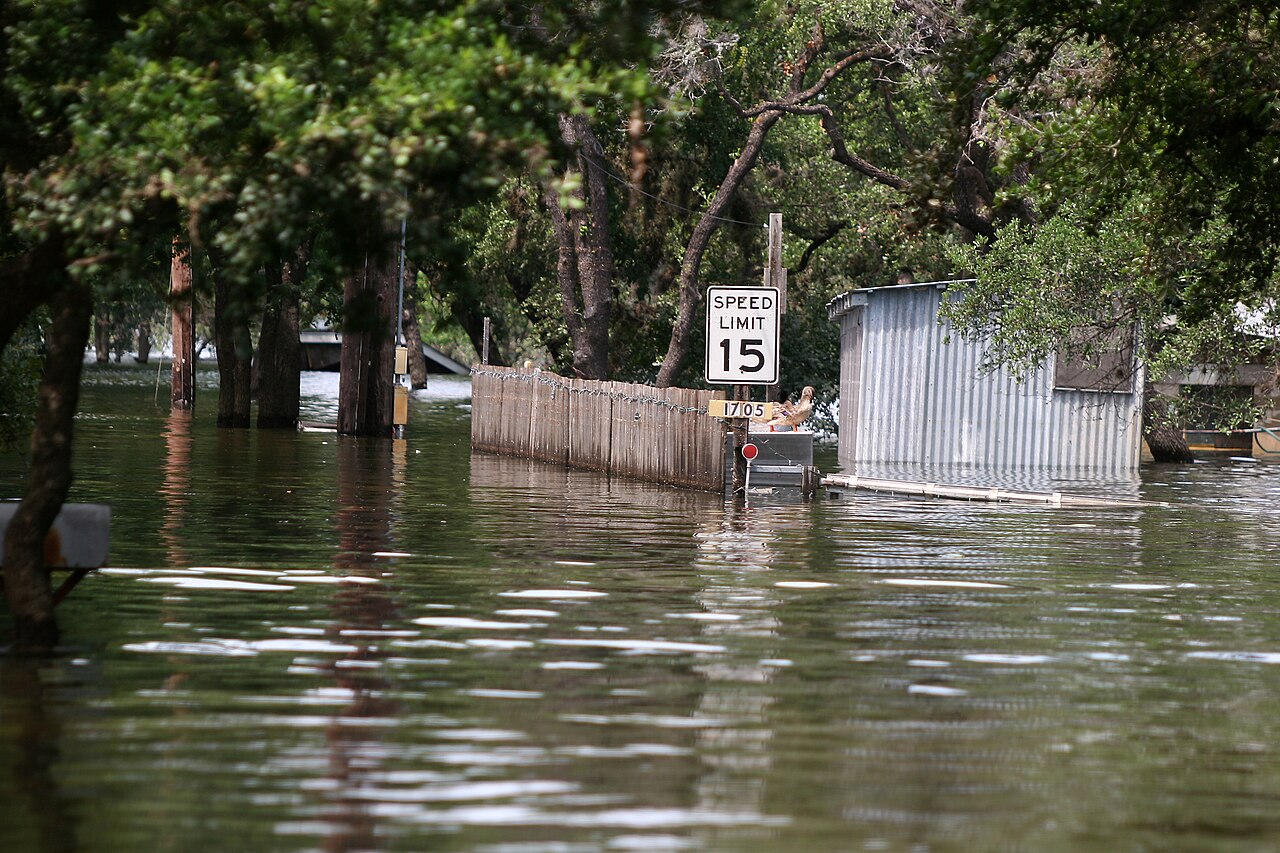
Every year, some number of American families stand in a ruined living room, call their homeowners insurance company, and learn the sentence no one believes until it happens to them: flood damage is not covered. Not partially covered, not covered with a high deductible. Excluded. The water that rose from the street, the creek, or the saturated ground is a different peril, sold under a different policy, and if you did not buy that policy, the loss is yours.
This is the single most expensive gap in American household insurance, and it persists because of a misunderstanding: people assume “homeowners insurance” means “insurance for things that happen to my home.” It does not. Understanding the flood gap, and the federal program built to fill it, is worth doing this week, not the week a storm is on the map, because flood coverage typically cannot be bought at the last minute.
Why homeowners policies exclude flood
Standard homeowners and renters policies cover water damage from above and inside, roughly speaking: a burst pipe, a failed water heater, rain driven through storm damage. What they exclude is rising water from outside, such as overflowing rivers, storm surge, flash floods, and heavy rain that overwhelms drainage. Insurers exclude it because flood losses hit entire neighborhoods at once, a concentration of risk the private homeowners market historically would not carry at affordable prices. That is why Congress created the National Flood Insurance Program (NFIP) in 1968, run today by FEMA, which explains the program on its flood insurance page. You buy an NFIP policy through regular insurance agents and companies, but the coverage itself is federal.
What an NFIP policy covers
NFIP coverage comes in two separate pieces, and you can buy one or both. Building coverage protects the structure and its systems, things like the foundation, electrical and plumbing, furnace and water heater, and built-in appliances, up to a limit of $250,000 for a residential building. Contents coverage protects your belongings, such as clothing, furniture, and electronics, up to $100,000, per the program details on FEMA’s FloodSmart.gov. Renters can buy contents-only coverage, a fact that surprises many tenants who assume flood insurance is a homeowner’s product.
Know the limits of the limits. Basements get restricted treatment: certain items and finishes below the lowest elevated floor are covered narrowly or not at all. And if your home would cost more than $250,000 to rebuild, an NFIP policy alone leaves you underinsured; private “excess flood” coverage exists to stack on top. Private primary flood insurance has also grown in recent years and can be worth comparing on price and coverage, especially for higher-value homes.
The 30-day rule: you cannot buy it when the storm is named
An NFIP policy generally takes effect 30 days after purchase. The waiting period exists precisely to stop people from buying coverage only when water is already on the way, and it has narrow exceptions, most notably when coverage is purchased in connection with making, increasing, extending, or renewing a mortgage loan. The practical translation: flood insurance is a decision for a calm, dry month. By the time a hurricane has a name and a forecast cone, the window for this year has usually closed.
Who actually needs it
If you have a federally backed mortgage on a home in a high-risk flood area, a Special Flood Hazard Area on FEMA’s maps, flood insurance is not optional; your lender is required to require it. Everyone else gets to choose, and this is where people misjudge the risk. Flooding happens in every state, not just on coastlines, and FEMA notes that a large share of flood claims come from properties outside high-risk zones, where policies are also generally much cheaper. “I’m not in a flood zone” is not quite a real sentence; nearly everyone is in a flood zone, the question is which one. You can look up your address on FEMA’s Flood Map Service Center and see your mapped zone in about a minute.
Bear in mind that maps are backward-looking and rainfall patterns are not static. New construction upstream, changing storm behavior, and aging drainage can put water where the map never showed it. FloodSmart’s often-quoted rule of thumb, that even an inch of water in a home can cause tens of thousands of dollars in damage, is the right frame: the question is not whether you live on a riverbank, but whether your finances could absorb a flooded first floor uninsured.
What flood insurance costs, and what disaster aid does not do
Premiums under FEMA’s current rating system are set property by property, based on factors like distance to water, elevation, and rebuilding cost, so quotes are the only honest way to price your own home; an agent can quote NFIP and private options together. As you weigh the cost, retire the most dangerous assumption in this topic: that federal disaster assistance will make flooded homeowners whole. Disaster aid requires a presidential declaration, much of it comes as loans that must be repaid, and grant amounts are typically far below what a serious flood costs. Insurance pays because you have a contract; aid, when it comes at all, is a safety net with wide gaps.
The flood exclusion is buried in the fine print of every homeowners policy in the country, but it only becomes real on the worst day a house can have. Spend the minute on the flood map, get a quote while the sun is out, and make the choice on purpose. Either answer can be reasonable. Discovering the gap with water at the doorstep never is.